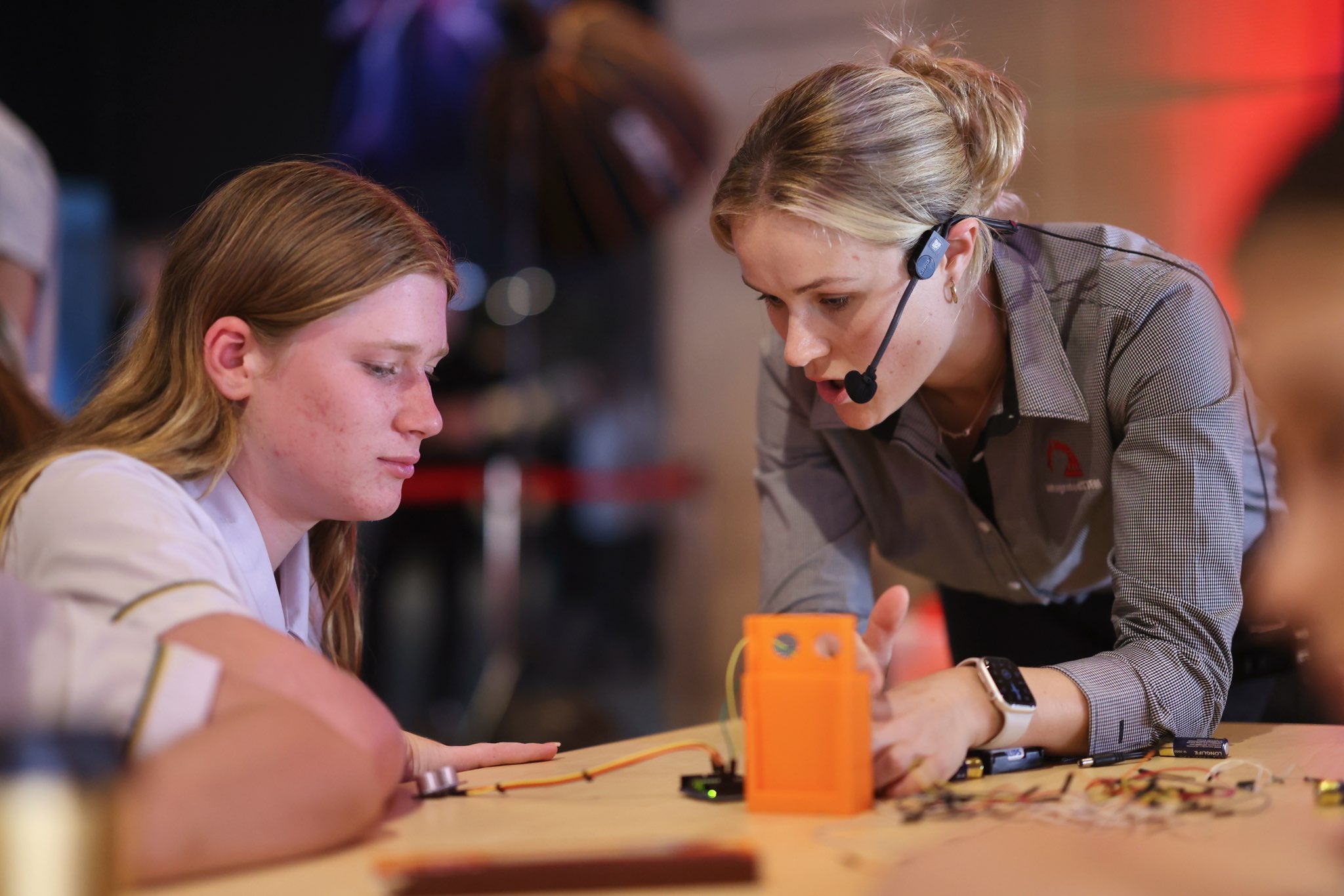
We were thrilled to be invited to the World Science Festival in March, hosted by the incredible Queensland Museum. Our team made a lasting impact at this fantastic event by running workshops featuring our much-loved spy robots! With their sleek 3D-printed bodies and moustachioed heads, these robots provided the perfect way to introduce both primary and secondary students to hands-on robot construction.
Wait, the Kids Built Robots?
Absolutely! We guided the students through programming and coding, discussing various input and output devices. The students eagerly shared examples of inputs and outputs they’ve encountered in everyday life, making the learning experience interactive and relatable.
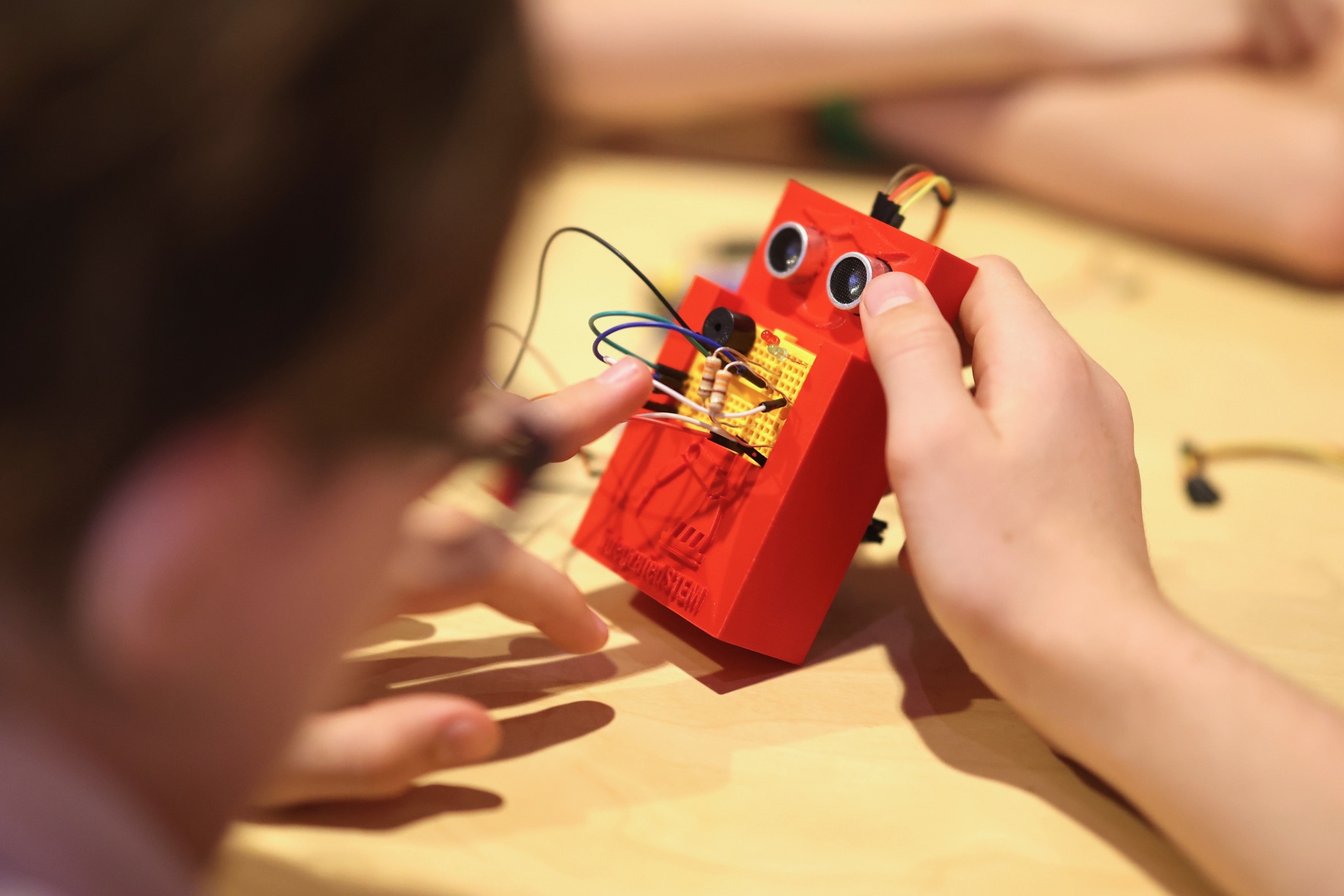
We introduced the students to breadboards and explained how they conduct electricity. With this new knowledge, they wired up the circuit outputs, including two indicator LEDs (one red and one green) and a buzzer to alert when the robot detects an object.
But How Do the Robots Detect Objects?
The robots used a special input called an ultrasonic distance sensor. By emitting ultrasounds—sounds beyond human hearing—the robot could “see” its surroundings. Instead of using eyes or cameras, the robot employed echolocation, much like bats and dolphins do to navigate.
Once the ‘eyes’ were connected as inputs to the Arduino, the system came to life!
But What is an Arduino?
An Arduino is a small, programmable microcontroller that acts as the brain of many electronic projects. In our workshop, it served as the core of the spy robot, controlling its inputs and outputs. By using simple code, students instructed the Arduino to process information from sensors—like the ultrasonic distance sensor—and control devices such as LEDs and buzzers. The Arduino provided an excellent hands-on introduction to electronics, giving students a deeper understanding of how everyday devices function through coding and circuitry.
It’s important that our students use Arduinos because they are commonly employed in the prototyping stage of the robotics industry.
Is That It?
Not quite! For our advanced learners, we issued a challenge to test their knowledge of the concepts we had taught them. We tasked them with reverse-engineering the spy robot to sound an alert when **something wasn’t** in front of it. The idea was to create a system that could notify you if something, like your ice cream, was stolen from the freezer! The students enthusiastically accepted the challenge, working to reverse how the system operated.
Why This is Important
It’s essential for students to engage with this technology as early as possible. Through our workshop, they developed skills crucial to the robotics industry, using tools that professionals rely on. This hands-on experience helps students bridge the gap between theoretical learning and real-world application, giving them a head start when considering future careers in tech, engineering, and more.
Special Thanks
We would like to express our heartfelt thanks to the World Science Festival and Queensland Museum for hosting such an amazing event and allowing us to be a part of it. We’re incredibly grateful for the opportunity and can’t wait to return next year!